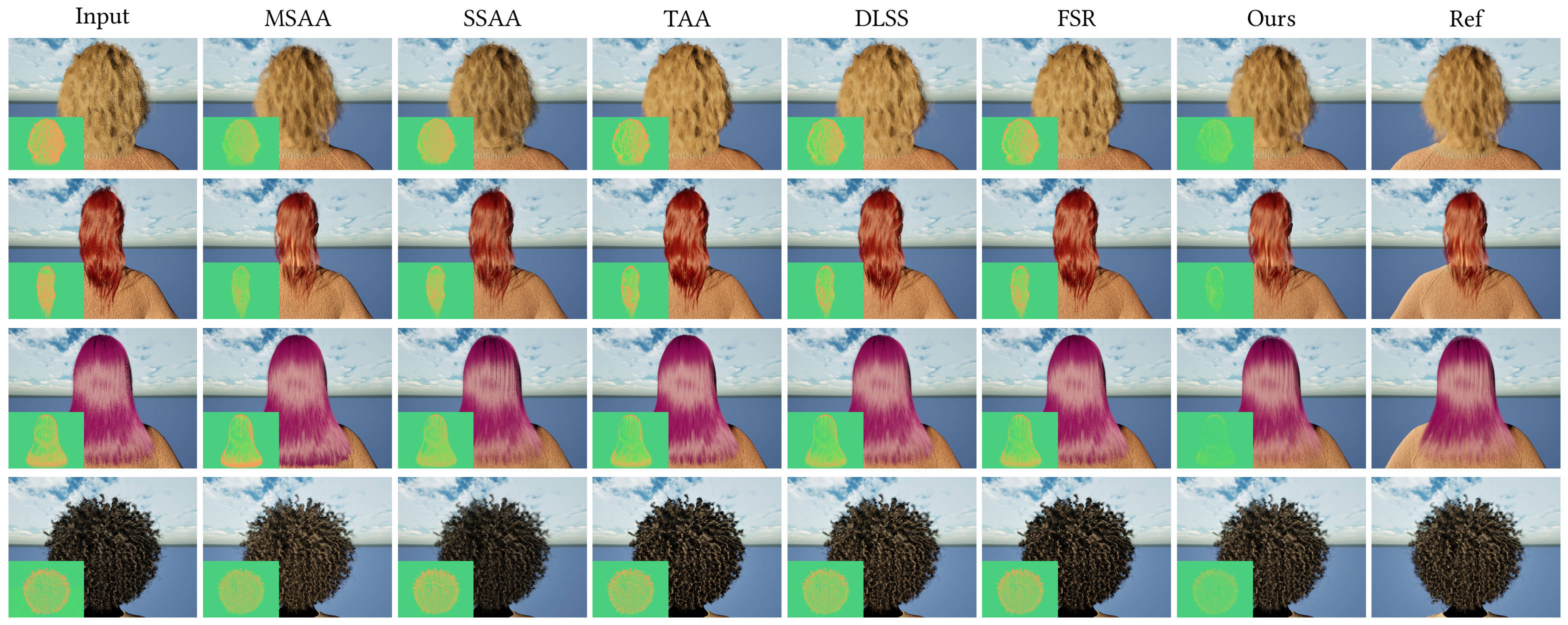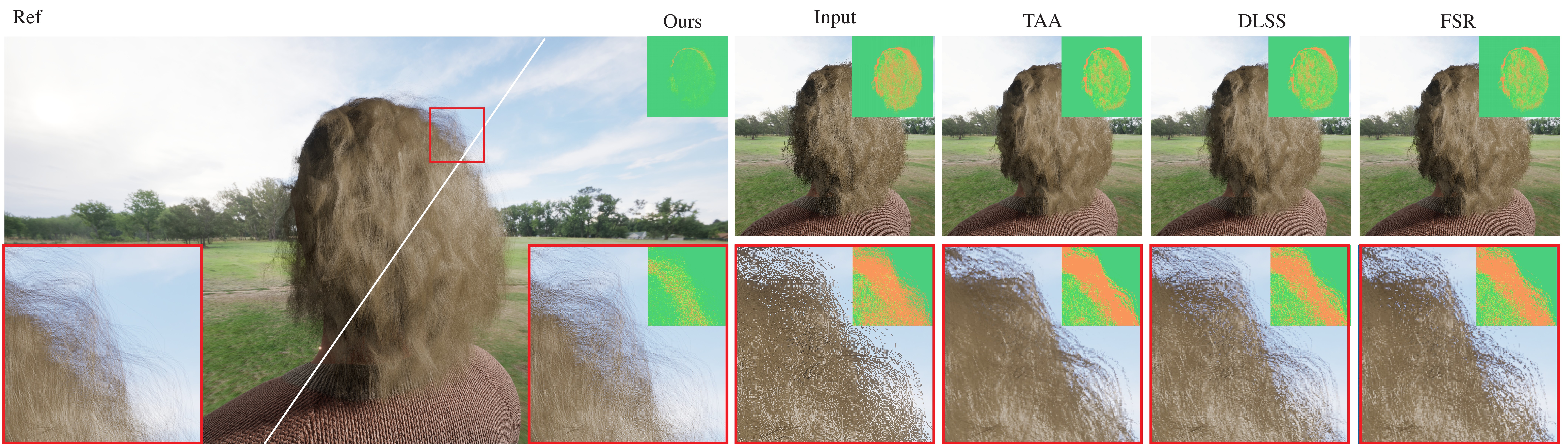
We propose a lightweight real-time method for reconstructing strand-based hair G-Buffers from severely undersampled rasterized inputs. Our pipeline first applies neural spatial reconstruction and temporal accumulation to recover hair coverage, i.e., fractional hair visibility within a pixel, and tangent. It then uses a tangent-guided reconstruction step to complete the position, which is subsequently used for physically based deferred hair shading. We evaluate our method across a diverse set of hairstyles, including straight, wavy, afro, and ponytail styles, under both static and dynamic scenarios. Our method achieves higher hair reconstruction quality than existing hair-specific denoising techniques and general industrial neural reconstruction solutions such as DLSS and FSR.